Mark this day! 10th November, 2018

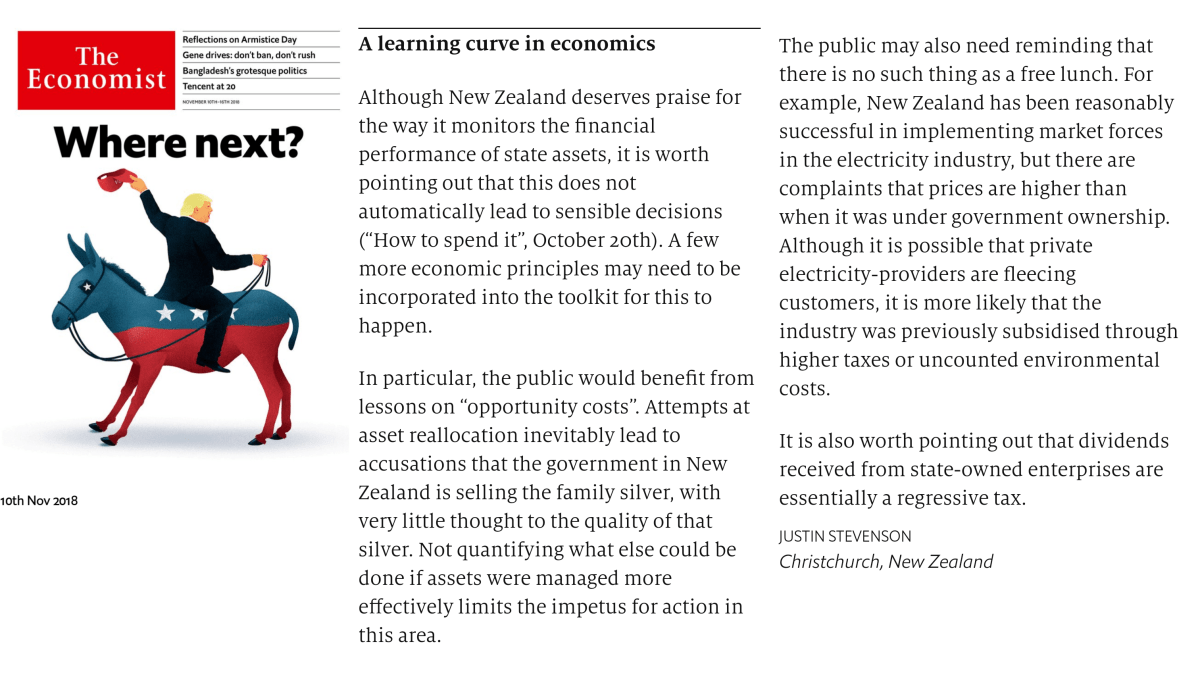
I have reached the summit! The Economist has published a letter by me! Little old me! Admittedly, this means that I share the same page as ambassadors for despot countries, desperate to defend their nation’s record against the latest Economist feature, but who cares!

For those interested in the topic, whenever NZ is featured in an article it is either rare, brief, and usually, favorable. In this case, it was all three as NZ received top billing as a country where government-owned assets were accounted for. High praise indeed.

While I think this is probably true, I felt that is was necessary to point out that knowing stuff does not lead to great decisions. The ongoing battles about this in NZ are a testament to this.

As it was The Economist did truncate the letter a bit, even dropping the Dr from my name. Here is the full text

_________________________________

Dear Sir

Although New Zealand deserves praise for the way it monitors state assets and their financial performance (“How to plug budget holes by managing public wealth better”, Oct 20th, 2018), it is worth pointing out that knowing what is going on does not automatically lead to sensible decisions.  A few more economic principles may need to be incorporated into the toolkit for this to happen.

In particular, the public would benefit from lessons on “opportunity costs”. Attempts at asset reallocation inevitably lead to accusations that the NZ government is “selling the family silver” with very little thought to the quality of that silver. Not quantifying what else could be done if assets were managed more effectively limits the impetus for action in this area.

They also need reminding there is “no such thing as a free lunch”. As an example, while NZ has been reasonably successful in implementing market forces into its electricity generation, there are complaints of higher prices than under government ownership. While it is possible that private electricity providers are “fleecing” customers, it is more likely that the industry was previously subsidised via higher taxes or uncounted environmental costs.

It is also worth pointing out that dividends received from state-owned enterprises (SOEs) are essentially a regressive tax.  For context, dividends from SOE’s in NZ are equivalent to about US$700 per person, effectively a flat tax paid equally irrespective of income.

A potential improvement would be for SOE dividends to be paid directly to citizens rather than into the government coffers. This income would then be taxed at respective marginal tax rates, addressing the equity issue.  It would also go some way to making the opportunity cost of poorly performing assets more real as it would affect everyone’s back pocket.

Dr. Justin Stevenson

Christchurch

New Zealand

Why is this here?!

I realise this is a minor issue, and it really shouldn’t bother me, but why do they publish the answer to the previous days Sudoku in the paper? Surely you can just look at your answer and check. If it is right, it’s right!

Interestingly, unless the Sudoku is “well-formed”, there may be multiple solutions. If all the conditions are met then your answer is correct, even if it doesn’t match the published version. There is no such thing as a “better” answer.

Honestly, what a waste of space. Put another puzzle in instead.

Electric Bikes – an early adoptor

This is a bit of a fun piece on E-bikes that STUFF were keen to run with.  Who knows, it might be the most valuable bit of work I ever do…:-).

For the record, this got published because I had to get hold of the editor of The Press regarding my other opinion piece on asset sales . I was contacted by the CEO of Red Bus asking to meet to discuss things and I was a bit concerned I was going to get sued. I had to do some hurried checking of where I stood.  Thought while I was at it I should pitch some other work as my previous contact had left The Press.

On another note, as it got published in The Dominion as well, Jess is now famous in the whole country! 🙂

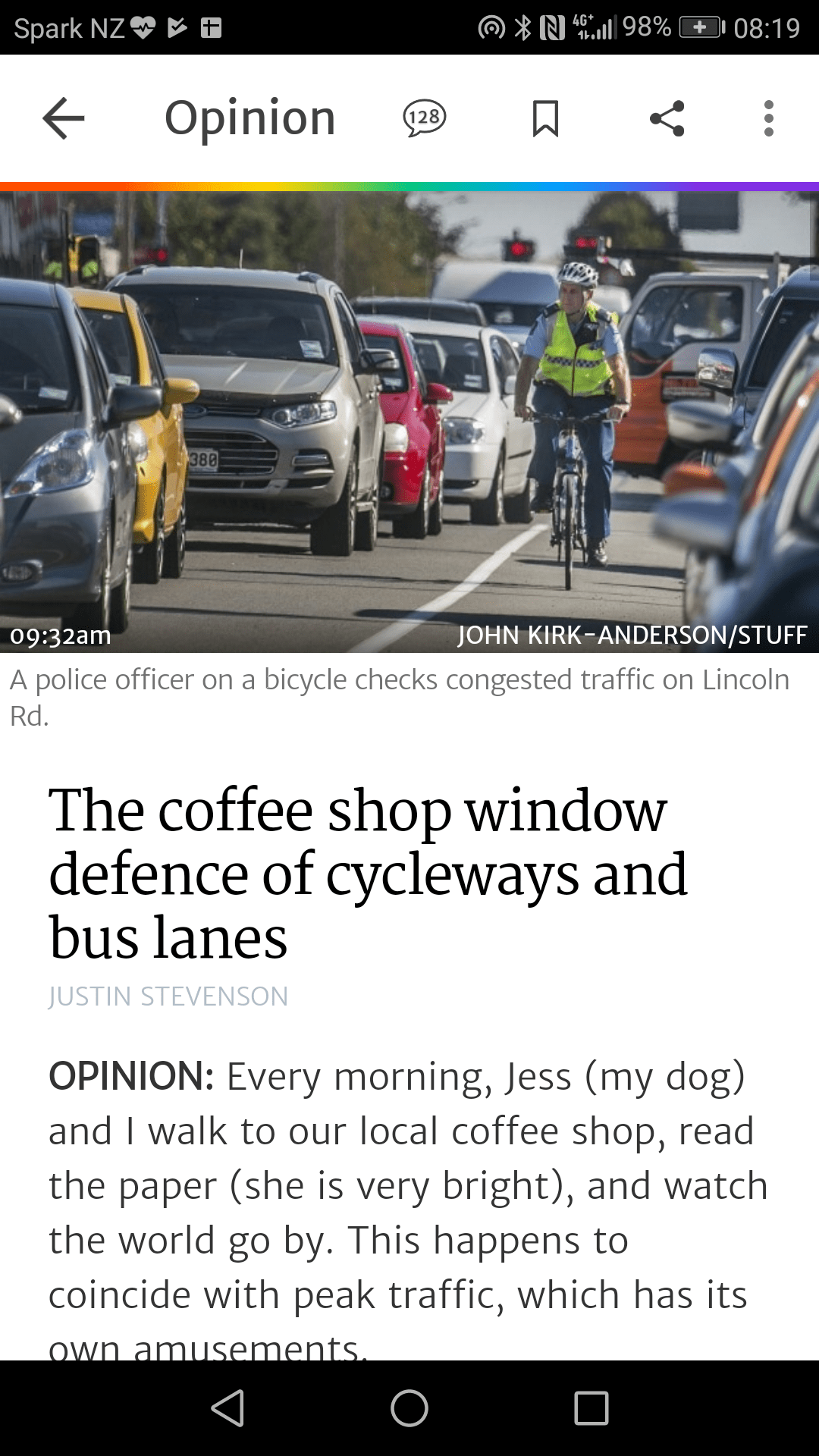
Get with the picture – why electric bikes are awesome!

While reading an article describing the massive international uptake of electric bikes, I realised that for the first time in my life I was an early adopter of something! I am usually behind the eight ball with new technology, but as an electric bike rider since 2010 I was practically on the bleeding edge of early adoption.

However, in 2018 e-bikes are now everywhere, even in New Zealand.

For holdouts wondering what all the fuss is about, here are my top 5 reasons to take the plunge.

Speed

I had been flirting with the idea of an electric bike for a while, but the final straw was being caught in three traffic jams on a short car trip. I could have walked faster! Between; being first through lights, using bike lanes, and being able to park close to my destination, I find that journeys under 8km take a similar time to a car, despite only trundling along at 28km/h.

Wind

A major downside of riding in Christchurch is having to battle the northeast wind. This menace is as regular as clockwork in summer, and a drag to have to face after work every afternoon. On an electric bike – no problem

Clothes

To avoid sweat, needing a shower and another set of clothes, bike journeys had to be kept less than 5km. With an electric bike you can wear whatever you like. Even cold winters are fine. While other cyclist wait to warm up I put on a puffer jacket and stay nice and cosy. Admittedly, rain is still a problem, but not getting clammy in wet weather gear is a huge improvement.

Safety

This might be less obvious, but having the ability to accelerate rapidly, and being able to give my full attention to random car drivers rather than peddling, has meant that negotiating traffic was far less problematic. Regular close calls have become far rarer.

Money

I confess cost, rather than fitness or environmental concerns, has been my main motivation to bike. While the initial outlay is a bit more than for normal bikes, electric bikes are way cheaper to run than a car. But the real bonus is that electric bikes make getting rid of a car, and avoiding the massive depreciation cost, a distinct possibility.

One of my “later adopting” friends admitted that he hadn’t realised what having an electric bike would mean. Previously, only 50% of his journeys could be easily done on a normal bike. With an electric bike this figure jumped to about 90%+! It basically relegated his second car to the garage.

However, If you are ready to take the leap there are a few warnings.

Normal cyclists will judge you. Not only are you violating some sense of ethical purity associated with using a “proper bike”, you will face the inevitable “you wont get fit on that” comment. To which the only response is “I am comparing this to a car, not a bike”

As for car drivers, be gentle. It can be difficult to admit that a bike could be more convenient and pleasurable than a car. In my experience, they simply do not believe that whenever possible I would prefer to use an electric bike over a car.

The other warning is slightly strange. Early on a friend pointed out that the other person he knew with an electric bike ended up in Golden Bay smoking dope. I know what he is getting at. Riding at 28km/h feels very quick, on an electric bike it feels like a dawdle. Becoming a hippy feels like a distinct possibility.

My electric bike is no longer unique, so to keep ahead of the game so I have purchased an electric cargo bike. Now Jess the dog is happy as well as she can come along for the ride.

Top that you technological laggards!


Not quite as impressive

So this was a bit of a random effort but The Press picked it up but ran with it – in STUFF anyway. Those of you following this blog will recognise it as a slightly modified version of a

Those of you following this blog will recognise it as a slightly modified version of a previouse post.

I was under the impression that it would be in the paper as well. Alas. I must be getting old as the having it a physical form still feels more real than having it online. How things change.

Judging from the comments I probably didn’t convince many people. 50/50 for and against, and far less response than the previous effort.

On that note though, what is it with some people who comment? In most cases they clearly took whatever they wanted out of it rather than what I tried pretty carefully to convey.

For the record, this piece is looking at a specific “edge” case where cycleways and public transport MIGHT be a good solution and be of benefit those who drive, i.e. when, and only when, traffic is already heavy. When traffic is flowing well then other arguments come into play. In particular, within reason, people should be able to travel around in whatever way they prefer. Admittedly this is a harder argument as the costs and benefits between users are not as clear and harder to quantify.

Theology of Economics – Part 1

This is a sermon that I gave at Ilam Baptist Church trying to flesh out the links between economics and theology. They have changed their website recently so I now have to host it here on the odd chance that people might want to listen to it.

This sermon was partially given because I was getting extremely frustrated with the dominant econ/theology views being expressed. They were either people with a strong theology background who dabbled in economics because they perceived, rightly or wrongly, that there was some social justice issue to address, or they were mildly rabid christian capitalists who believe (perhaps correctly :-)) that the market is a gift from God and can’t be critised. I am not comfortable with either of these perspectives as I don’t think it does justice to theology or economics.

Naturally I like to think that I have a unique, and of course absolutely correct (:-)) view, but I will let you be the judge.

Clearly being labelled “Part 1” indicates that there are more to come – an in due time I will post the second.

By the way, I used a relatively large Monty Python sketch in this sermon to set the scene. If you want to watch it on YouTube, here is the link but it is very skipable.

Also, you will need to follow along with the Power Point Slides which I have attached. It should be pretty easy to figure out when to move along.

By the way, I am always on for discussion about this so fire away.

Happy listening.

Theology and Economics 201407