Graph of the Month – December 21′

While searching for a topic that I could feasibly imagine writing about on a semi-regular basis, it crossed my mind that yes, I do enjoy a good graph! I particularly enjoy graphs that illustrate a reasonable course of action i.e. they are useful.

Of course, I also enjoy pillorying graphs that are complete rubbish. Especially when they are being used to promote a perspective with a lot more certainty than the data would support.

Therefore, I thought I would try publishing a graph every month that I think is worthy of discussion – for good or bad reasons. Surely I could manage one a month!

To kick things off, the graph below was published in The Economist in an article considering the most effective way to reduce carbon, and therefore address climate change (Giving up the carbs: What is the cheapest way to cut carbon? The Economist, Feb 27, 2021). This article was in response to Bill Gate’s book addressing this issue. While well-received for providing a realistic, science/engineering based perspective on what was ACTUALLY required, unfortunately, its impact was slightly dented by revelations of his involvement with Jeffrey Epstein and then his subsequent divorce. Shame.

What does the graph show?

  • The x-axis shows the total amount of carbon that can be abated (gigatonnes of CO2)
  • The y -axis shows the cost ($’000/ per ton of CO2) that it will cost to get rid of that carbon
  • The data then shows the cost of reducing carbon from key areas, with the lowest (in fact negative) costs shown first.

What does the tell us?

If you were serious about addressing carbon emissions then:

  • Typically, there is a whole lot of low hanging fruit where we can get significant reductions for a relatively low cost.
  • Alas, this low hanging fruit is not particularly “sexy”, and is sometimes feels inadequate – i.e. big wins can be achieved by burning carbon-producing gas rather than really, really carbon-intensive coal. Still bad, but a lot better than the alternative.
  • Electric cars/trucks will be necessary but do not return a great bang for your buck.
  • There is a lot of carbon emissions where we simply do not have the technology to deal with at the moment no matter how much we pay.

Why do I like this graph?

  • Admittedly I like sticking it to people who talk big, but don’t do the basics well. There is a whole lot of stuff that will make a real difference but is unlikly to make the papers.
  • I like that it leads you to counterintuitive results. Instead of spending money of buying an electric car, if you area really seriouse about reducing carbon there are more effective things you can do, even if they are done by others.
  • Which makes NZ’s purchase of carbon credits from other countries seems more sensible. We could spend money reducing carbon here but the options are probably quite expensive. We can get more carbon reduction bang for our buck by paying other people to do it. Afterall, the world doesn’t care where the carbon reductions come from!
  • Once again, this graph rams home that some mechanism for pricing carbon is probably the best chance we have of reducing carbon in a sensible way as it allows us to rank the most cost effective methods.
  • However, it is also clear that we are gong to need a lot more research! We simply have to get inventing different ways to solve the big chunck of carbon which we have no feasible way of dealling with at the moment. I personally think that lifestyle changes are not going to cut it, we have to engineer our way out of this!

How could the graph be improved?

  • The biggest improvement would be to change the x-axis scale to a percentage of the total carbon currently emitted. While the current figures look large it is unclear if the carbon that can feasibly be reduced is a significant percentage of what is emitted, or if the amount that we have no solution for is actually overwhelmingly large, as the axis has no upper limit. In its current form, it looks like it is about 15% of emissions that we can’t deal with at the moment, I suspect it is much higher.

Any thoughts on this graph and/or my interpretation would be well received. If you have any personal favourites feel free to send them in.

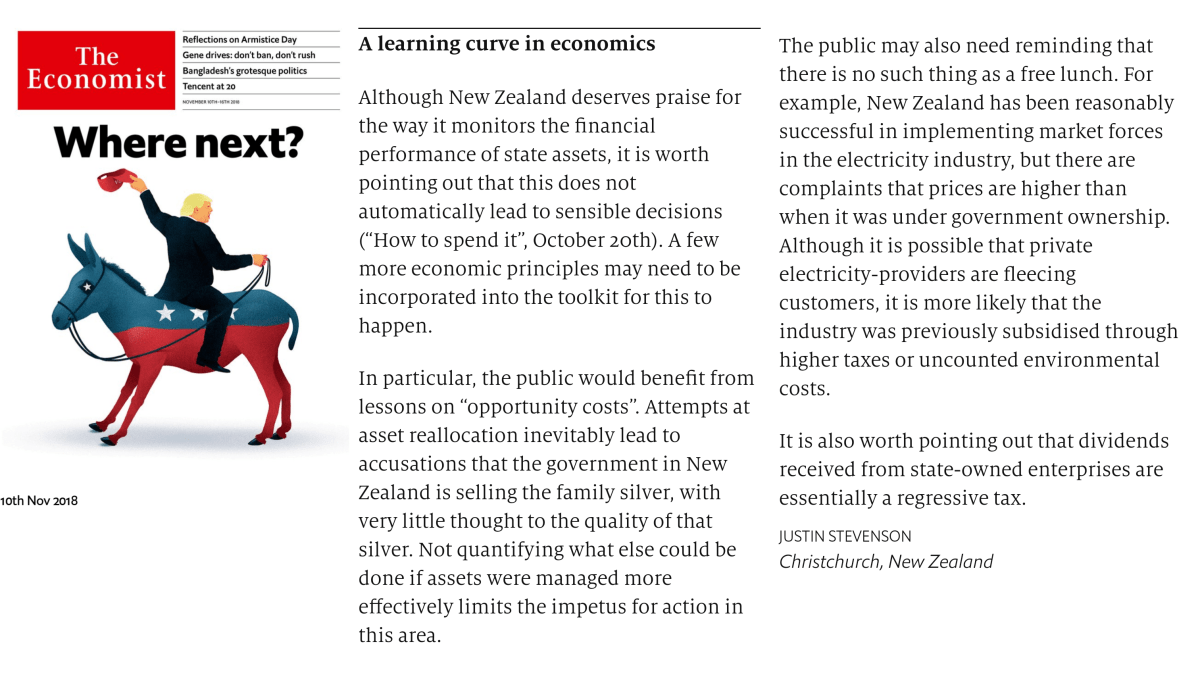
Mark this day! 10th November, 2018

I have reached the summit! The Economist has published a letter by me! Little old me! Admittedly, this means that I share the same page as ambassadors for despot countries, desperate to defend their nation’s record against the latest Economist feature, but who cares!

For those interested in the topic, whenever NZ is featured in an article it is either rare, brief, and usually, favorable. In this case, it was all three as NZ received top billing as a country where government-owned assets were accounted for. High praise indeed.

While I think this is probably true, I felt that is was necessary to point out that knowing stuff does not lead to great decisions. The ongoing battles about this in NZ are a testament to this.

As it was The Economist did truncate the letter a bit, even dropping the Dr from my name. Here is the full text

_________________________________

Dear Sir

Although New Zealand deserves praise for the way it monitors state assets and their financial performance (“How to plug budget holes by managing public wealth better”, Oct 20th, 2018), it is worth pointing out that knowing what is going on does not automatically lead to sensible decisions.  A few more economic principles may need to be incorporated into the toolkit for this to happen.

In particular, the public would benefit from lessons on “opportunity costs”. Attempts at asset reallocation inevitably lead to accusations that the NZ government is “selling the family silver” with very little thought to the quality of that silver. Not quantifying what else could be done if assets were managed more effectively limits the impetus for action in this area.

They also need reminding there is “no such thing as a free lunch”. As an example, while NZ has been reasonably successful in implementing market forces into its electricity generation, there are complaints of higher prices than under government ownership. While it is possible that private electricity providers are “fleecing” customers, it is more likely that the industry was previously subsidised via higher taxes or uncounted environmental costs.

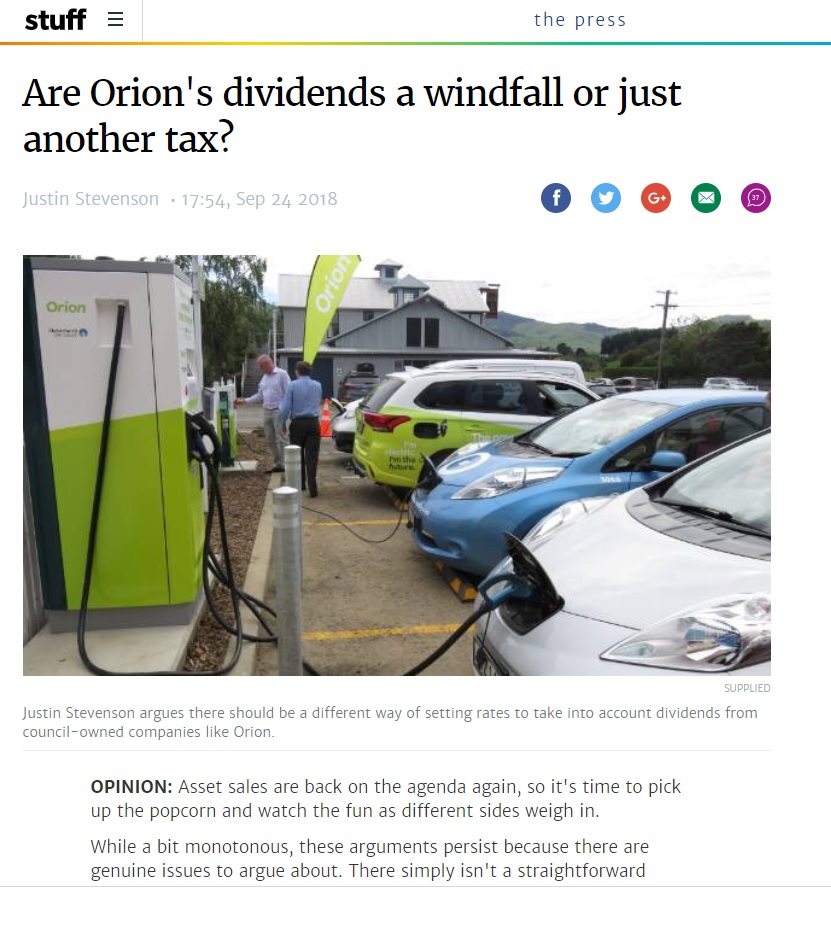
It is also worth pointing out that dividends received from state-owned enterprises (SOEs) are essentially a regressive tax.  For context, dividends from SOE’s in NZ are equivalent to about US$700 per person, effectively a flat tax paid equally irrespective of income.

A potential improvement would be for SOE dividends to be paid directly to citizens rather than into the government coffers. This income would then be taxed at respective marginal tax rates, addressing the equity issue.  It would also go some way to making the opportunity cost of poorly performing assets more real as it would affect everyone’s back pocket.

Dr. Justin Stevenson

Christchurch

New Zealand

Why is this here?!

I realise this is a minor issue, and it really shouldn’t bother me, but why do they publish the answer to the previous days Sudoku in the paper? Surely you can just look at your answer and check. If it is right, it’s right!

Interestingly, unless the Sudoku is “well-formed”, there may be multiple solutions. If all the conditions are met then your answer is correct, even if it doesn’t match the published version. There is no such thing as a “better” answer.

Honestly, what a waste of space. Put another puzzle in instead.

Immigrants and refugees – good odds to be economically beneficial

I was playing around with this piece thinking that it might be a good way to bring people into the UBI debate (believe it or not) when,  inevitably, the issue of refugees hit the headlines when Winston Peters shot down Labour’s plan to increase NZ’s refugee numbers. 

One of the good (or bad) things about this was that the comment section in STUFF gave me an insight into the general public attitude to this issue. It was not encouraging. I confess, I chickened out and decided not to submit it. The comment section was so vitriolic that putting my head above that parapet was something I was unwilling to do unless the answer was overwhelmingly obvious. 

As it is, even if the economic debate over migrants and refugees is not completely conclusive, I think that it is so difficult to conclude that they are a cost that we might as well ignore this as an issue.

However, I actually don’t think the economics are the actual issue for most people. 

__________________________________

There are many arguments for and against accepting immigrants and refugees into a country. The big debates revolve around humanitarian, cultural, security, infrastructure, and, inevitably, economic concerns.

Of these, you would think that determining if a group are net economic contributors to the country, or not, should be a relatively easy problem to solve.

If the answer is reasonably clear we can get it out of the way early on.

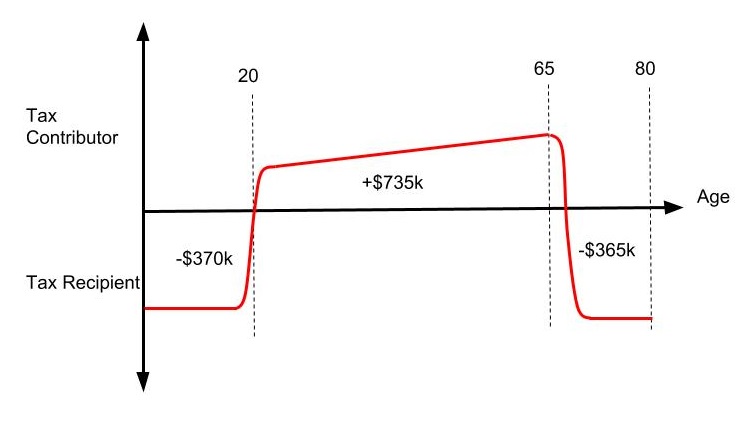
As it happens a “back of the envelope” analysis indicates that as a group, immigrants and refugees are odds-on favourites to be net contributors to society. To understand why, consider the figure below which roughly plots the net tax contributions throughout the life of an “average taxpayer”, along with some rough numbers.

An economic argument for immigrants and refugees

Figure: Tax contributions and expenses for the “average taxpayer”

First, the “average taxpayer” is a compilation of everyone in society, combining high and low earners, and the tax that they pay and spend over the course of an average lifespan.

There are some costs that cannot be tagged to a particular period of life and which are incurred by all residents. Think of these as “core government services” such as roads, defense, law and order and such like. These are a consistent cost paid every year by everyone.

Other contributions and expenses occur during defined periods of life.

Until they reach around 20 years of age the average taxpayer will be costing society money. In this period of their life, they are unlikely to be paying tax while going through the expensive process of being born, surviving past 5, getting a compulsory education, and transitioning to work. This is all very expensive.

Between the ages of 20 and 65, the average taxpayer will be working, contributing tax dollars while not incurring any predictable expenses specific to that age bracket. This is when they make their positive contribution to the tax take.

At 65 they will get NZ superannuation, work less, and become increasingly dependent on the health system. They are almost certainly going to use more tax dollars than they contribute.

The key takeaway from this analysis is that if you are an average taxpayer then, give or take a bit, all these costs and benefits should nett out to zero. Your contributions in the middle years of life should basically equal what it costs in your early and later years. And that is the way it should be.

It’s a bit rough, and there are also a few wrinkles not accounted for, in particular, whether the average taxpayer has any tertiary training or not and how to treat consumption taxes during retirement, however, it’s good enough to make some predictions.

For example, this model represents the average person born here. What about if you move here later in life?

Consider the “economically optimal” immigrant or refugee – someone who arrives ready to work at 20. In this case we get all the tax contributions in their working life, still have to pay the costs post 65, but miss out having to bring them into the world and educate them. By removing this large expense at the beginning of their life, to be tax neutral they really only have to contribute around 70% of the average tax as someone born in NZ. In short, they are unlikely to be a drain on the public purse.

What if they are younger? While there are clearly more education costs, the chances of them being more like the “average taxpayer” become higher and higher the younger they get. It would be extremely unlikely that an immigrant who arrived at age 1 would end up vastly different to a born and bred kiwi, and we don’t complain about them.

Clearly, things do get more problematic as immigrants get older as they have fewer years to contribute towards their retirement. This is particularly an issue when considering “family reunification” policies, and is justifiably treated with care. However, assuming they can earn roughly the same as average taxpayers, migrants who end up eligible for superannuation would have to be older than 45ish before this became problematic.

Refugees have a bit more of an economic headwind to overcome as it is deemed necessary to spend around $80-100K to ease their passage into society. However, given it costs around $370K to get a NZ born resident to age 20, they are probably still odds-on to be a positive contributor if their average age is between around 35-40.

Remember, that this analysis is comparing the average immigrant and refugee with the average taxpayer. Everyone will have specific examples which differ in either positive or negative ways. Economically it is fairer to consider immigrants and refugees as a group allowing their foibles and benefits to offset each other while leaving the group’s true overall contributions intact, just like we do for all New Zealanders.

It is also worth considering that there is an even more “economically optimal” migrant than described above. These arrive aged around 20, work for a while, start pining for home and leave before obtaining any rights to a pension. It is pretty much all upside for us. If this sounds familiar it is because NZ is pretty good at producing these for the benefit of other countries. We call it “having an OE”.

If someone spends 10 years overseas during their working years then they have to pay around 20% more than the average amount of tax while in New Zealand to break even over their lifespan.

In no way am I wanting to discourage people from taking an OE as I think it adds to the cultural fabric of New Zealand. However, if you feel the need to point the economic gun at anyone for not contributing their fair share, then they are a more likely target.

Depending on your view of the world there may be significant concerns involved with immigration, however, financial costs are unlikely to be a legitimate one. If money was the only issue we should be looking for as many as we can get. However, invariably, economics will not be the only issue.

Electric Bikes – an early adoptor

This is a bit of a fun piece on E-bikes that STUFF were keen to run with.  Who knows, it might be the most valuable bit of work I ever do…:-).

For the record, this got published because I had to get hold of the editor of The Press regarding my other opinion piece on asset sales . I was contacted by the CEO of Red Bus asking to meet to discuss things and I was a bit concerned I was going to get sued. I had to do some hurried checking of where I stood.  Thought while I was at it I should pitch some other work as my previous contact had left The Press.

On another note, as it got published in The Dominion as well, Jess is now famous in the whole country! 🙂

Get with the picture – why electric bikes are awesome!

While reading an article describing the massive international uptake of electric bikes, I realised that for the first time in my life I was an early adopter of something! I am usually behind the eight ball with new technology, but as an electric bike rider since 2010 I was practically on the bleeding edge of early adoption.

However, in 2018 e-bikes are now everywhere, even in New Zealand.

For holdouts wondering what all the fuss is about, here are my top 5 reasons to take the plunge.

Speed

I had been flirting with the idea of an electric bike for a while, but the final straw was being caught in three traffic jams on a short car trip. I could have walked faster! Between; being first through lights, using bike lanes, and being able to park close to my destination, I find that journeys under 8km take a similar time to a car, despite only trundling along at 28km/h.

Wind

A major downside of riding in Christchurch is having to battle the northeast wind. This menace is as regular as clockwork in summer, and a drag to have to face after work every afternoon. On an electric bike – no problem

Clothes

To avoid sweat, needing a shower and another set of clothes, bike journeys had to be kept less than 5km. With an electric bike you can wear whatever you like. Even cold winters are fine. While other cyclist wait to warm up I put on a puffer jacket and stay nice and cosy. Admittedly, rain is still a problem, but not getting clammy in wet weather gear is a huge improvement.

Safety

This might be less obvious, but having the ability to accelerate rapidly, and being able to give my full attention to random car drivers rather than peddling, has meant that negotiating traffic was far less problematic. Regular close calls have become far rarer.

Money

I confess cost, rather than fitness or environmental concerns, has been my main motivation to bike. While the initial outlay is a bit more than for normal bikes, electric bikes are way cheaper to run than a car. But the real bonus is that electric bikes make getting rid of a car, and avoiding the massive depreciation cost, a distinct possibility.

One of my “later adopting” friends admitted that he hadn’t realised what having an electric bike would mean. Previously, only 50% of his journeys could be easily done on a normal bike. With an electric bike this figure jumped to about 90%+! It basically relegated his second car to the garage.

However, If you are ready to take the leap there are a few warnings.

Normal cyclists will judge you. Not only are you violating some sense of ethical purity associated with using a “proper bike”, you will face the inevitable “you wont get fit on that” comment. To which the only response is “I am comparing this to a car, not a bike”

As for car drivers, be gentle. It can be difficult to admit that a bike could be more convenient and pleasurable than a car. In my experience, they simply do not believe that whenever possible I would prefer to use an electric bike over a car.

The other warning is slightly strange. Early on a friend pointed out that the other person he knew with an electric bike ended up in Golden Bay smoking dope. I know what he is getting at. Riding at 28km/h feels very quick, on an electric bike it feels like a dawdle. Becoming a hippy feels like a distinct possibility.

My electric bike is no longer unique, so to keep ahead of the game so I have purchased an electric cargo bike. Now Jess the dog is happy as well as she can come along for the ride.

Top that you technological laggards!


Tracking a Problem – Post 2

Datum: Latest Parkrun result 33:45 (Best 21:56, Worst: 33:45 (14/7/2018))


So today is an interesting day. I am starting on my drug treatment of Fingolimod tablets which, unless a new type of treatment emerges (very likely), I will now be taking for life. In theory, they are supposed to significantly reduce the number of relapses and keep MS issues at bay.

In the very short term (i.e. right now!), this involves spending a day being observed in the hospital day unit to make sure I don’t have an extreme reaction. In particular, there is about a 1:100 chance of having some form of cardiac response, which will then require an overnight stay. Apparently, they have given it to 200 people so far without any issues so I can’t see any issues there :-).

I then have to make sure I take the pills religiously for the next 2 weeks or else I will have to restart under monitoring again. After that, I can apparently miss a day but taking the pill will now have to be part of my new daily routine.

More broadly, as can be seen from the datum running time, things have not particularly improved symptoms wise. It’s a bit of a mixed bag but overall I am probably doing worse and not seeing the improvement I (we) had hoped for. This is a bit of a bugger.

My preference would be to have some idea where things are going to settle so I can build from that. However, I am beginning to suspect that the very nature of MS will exclude that.

The current status includes:

  • I have stopped doing the 5km park run. It is pretty tricky to do and there is is a pretty high chance of injuring myself from falling over and/or having to overly compensate style-wise. It also knocks me out for the rest of the weekend which is not great. I am contemplating doing for the ‘tail runner” role which is basically just walking so might be doable.
  • I have stopped drumming. Mainly because I couldn’t kick the base properly and my timing was out of whack. I might be able to figure something out for the former, and most probably don’t notice the latter, so that might come back.
  • Mountain biking is under threat. I seem to be losing my leg “push”, so getting up the hill was problematic on the last outing.
  • It looks like 2-3km is my comfortable walking distance. After that, I need to have a break.
  • It is looking like an afternoon nap might become part of life.

Anyway, other than that life carries on and hopefully the new drugs will improve things somewhat.

UPDATE: drug monitoring over and no cardiac issues so far.

More controversial and interesting, but not noticed – How to sell an asset without selling an asset

This piece was picked up by The Press and STUFF last week, which was nice.

Regular readers might recognise it as a rework of a previous post where I was making a case that arguments over public asset sales distracted from an easier debate over asset allocation. Since I didn’t get any bites about this orginal piece I was in the process of reworking it, pointing out that asset sales were happening under a different guise, when the whole topic hit the papers again. So in it went. 

I think the big lesson here is that if I want to get published in the paper regularly I will probably need 3-5 topics on the slow burn so I can take advantage of what is topical. I am not sure if I have that many topics! 🙂

The other interesting thing is that although it was in the paper (great!) to get rapid feedback you need to be on the front section of STUFF. In all there were only 12 comments, which was a bit of a fail really.

_____________________________

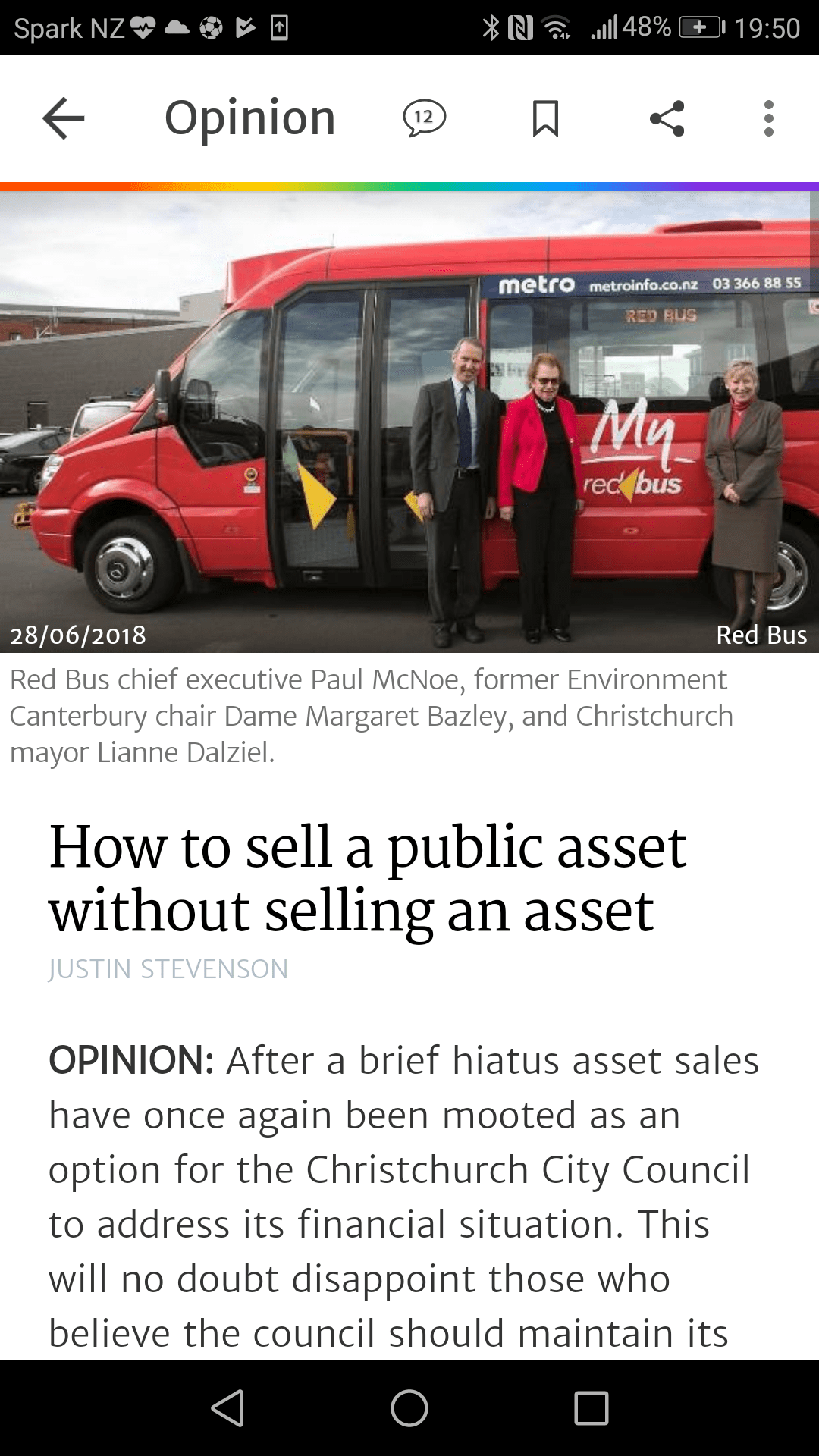
How to sell a public asset without selling an asset

After a brief hiatus asset sales have once again been mooted as an option for the Christchurch City Council to address its financial situation. This will no doubt disappoint those who believe the council should maintain its ownership stakes.

Those same people may be discouraged to learn that their opposition has not prevented a sell down on the sly. However, this is what appears to have happened with council owned Red Bus.

Red Bus is a bit of a problem child for the council and has been for many years. Not only does it struggle to retain bus routes in the face of private companies like Go Bus (an indicator of operational inefficiency for a public owned company), it barely makes a profit while sitting on a large amount of assets.

These assets could easily redeployed into better things (think “asset allocation” instead of asset sales), significantly benefiting the community.

While a good case could be made for selling Red Bus outright, it seems the risk of a PR backlash has meant that other avenues have been explored.

For example, the 2017 accounts indicated some odd behaviour. Despite make an operating profit of only $132,000 Red Bus was able to pay out a relatively hefty dividend of $1.35 million.

This is a good trick, but how was it achieved?

Despite a relatively small operating profit, a “consolidated profit” of $2.37 million was declared. For those wondering about the difference, the latter was largely the result of having extensive property assets revalued upwards by $2.38 million (+16%). A nice lift, but sitting on land and waiting for an increase in value is hardly a sign of managerial brilliance for a bus company. Pretty much all long term homeowners in New Zealand achieved this!

Red Bus then went to the bank, used the higher valuation to obtain a loan, and paid this money as a dividend to the CCC.

An equivalent situation would be using the increased value of your house to obtain a loan to pay for food. While it may be necessary at times, no one would suggest it makes you wealthier. You certainly cannot do it forever as eventually your equity runs out.

This is essentially what happened at Red Bus. The increase in value was sold to the bank for cash which was then passed onto the council.

This is called “releasing capital” which sounds better than “asset sales”, but both have the same effect of reducing the equity owned by the council.

Since paying a dividend of this size puts even more strain on a poorly performing company, significant pressure must have been applied. The substance of such actions are at odds to Mayor Lianne Dalziel’s statement that the council is “not considering asset sales”.

As it happens, selling down Red Bus is probably not a bad idea. Even in the latest financial year its return on assets was a miserable 0.8%. You could instead sell all the fixed assets in Red Bus, invest in a commercial property and receive 8 times as much for far less effort. Not doing so effectively costs rate payers around $2.3 million a year in lost income for no discernable benefit.

Although small compared to the overall council budget, $2.3 million a year is not chump change. There are clearly many good uses for this in Christchurch (I can certainly think of a few, can you?) and it is odd that the council has not taken advantage of this easy income stream.

The good news is that Red Bus is a small component of the council’s asset portfolio. With a bit more digging and some sensible asset allocation decisions the council’s financial position could be better than it appears.

_________________

Justin Stevenson has a Ph.D. in Engineering and a post-grad diploma in Economics. He really wants to see the city using its resources in a way that benefits the community the most.

If asset sales are no longer an option, how about asset allocation? (2018 update)

This is an updated version of the previous post “If asset sales are no longer an option, how about asset allocation?”   . Frankly, it didn’t take much work as not a heap as changed with the state of Red Bus

_____________________

All appearances suggest that asset sales are not being considered by the Christchurch City Council (CCC). This will please many as there are good reasons for keeping publicly owned assets. However, advocating for council ownership should not prevent sensible discussions about asset allocation.

Simply put, are CCC assets performing well, or should they swap them for something else? If we are going to keep the family silver, shouldn’t we make sure what we have is in fact silver!

For example, consider Red Bus. Is it worth the CCC owning this asset, or could it do better?

The annual report for Red Bus is freely available so we can get significant insight into this company’s performance. So what does this reveal?

With publicly owned companies it is inadequate to focus only on financial performance as there are often important, but more intangible, valuation considerations. They may be a monopoly provider, or they may provide some form of public good that the private sector would not deliver.

A useful thought experiment is to ask, “what would happen if this company ceased to exist?” What would be lost that the numbers do not show?

With Red Bus the answer is pretty clear, not much!

Despite appearances, Red Bus is not responsible for providing public transport in Christchurch. ECAN is. Red Bus simply tenders to provide bus routes along with other companies.

And they often lose. Currently only 30% of routes are performed by Red Bus with private firms like Go Bus delivering the rest.

If Red Bus stopped providing bus services your average bus user wouldn’t notice the slightest difference.

So why does Red Bus exist? It exists because the CCC believes it can operate a bus company profitably and receive a healthy dividend. Therefore, we can largely ignore any intangible benefits and focus primarily on its financial performance.

So how did they do?

Last year Red Bus declared a pre tax operating profit of $303,000 on turnover of just over $20.5 million. Better than last year but still a very skinny margin around 1.5%.

“running to stand still” is the phrase that comes to mind.

Of more concern is the amount of resources used to get this small profit. The accounts list net assets at a shade under $38 million, implying a return on assets of 0.8%.

If Red Bus was sold, and different assets purchased, what return could we expect from $38 million? As a comparison we could:

  1. Put the money into a bank deposit. With interest rates currently around 3.5% this is worth $1.35 million per year.
  2. Buy some industrial property. A 7% return should be possible so this is worth $2.6 million per year.
  3. Attempt to mimic the performance of Ngai Tahu’s commercial arm which made around 15% a year since settlement. This is around $5.5 million a year.

None of these options would compromise the provision of a public bus service. ECAN would simply contract to another company. In each case we would get the bus service PLUS the extra money.

A 7% return via option 2 is not an unreasonable expectation. What does Red Bus aim for? Apparently it has a target of $300k. Although they have achieved this “heroic” goal, 8 times this could have been achieved with far less effort!

Some conclusions can be drawn:

  • Red Bus is inefficient as even with its thin margin it can’t keep private providers (who tend to be very rational about profit) at bay.
  • Red Bus is very asset rich but makes virtually no return on those assets.
  • If the council wants a dividend from assets there are far easier options than owning this bus service.
  • Owning this company effectively wastes around $10 per ratepayer annually.

It would seem that selling up, letting others provide the bus service, and buying better assets is a reasonable alternative.

Red Bus is a tiny component of the CCC asset portfolio. However, even reallocating these resources could significantly improve the life of ratepayers. Even if only used for transport in the city an extra $2.6 million per year could be used to:

  • Give away 1 million free bus tickets to encourage more users.
  • Give 7000 bikes away.
  • Give 1500 E-bikes away.
  • Provide 86,000, $30 taxi trips.
  • An additional 3% more bus routes could be provided

These are just some options available, and they would be additional to the existing bus system.

Get creative. What would you do?

It is not unreasonably that all CCC owned companies should receive the same attention (hint, City Care deserves a look for starters). As ratepayers we should ensure that they are achieving even a basic level of performance so we are able to enjoy the benefits. As demonstrated with Red Bus, not doing so could be leaving our community significantly worse off than it could be.

Not quite as impressive

So this was a bit of a random effort but The Press picked it up but ran with it – in STUFF anyway. Those of you following this blog will recognise it as a slightly modified version of a

Those of you following this blog will recognise it as a slightly modified version of a previouse post.

I was under the impression that it would be in the paper as well. Alas. I must be getting old as the having it a physical form still feels more real than having it online. How things change.

Judging from the comments I probably didn’t convince many people. 50/50 for and against, and far less response than the previous effort.

On that note though, what is it with some people who comment? In most cases they clearly took whatever they wanted out of it rather than what I tried pretty carefully to convey.

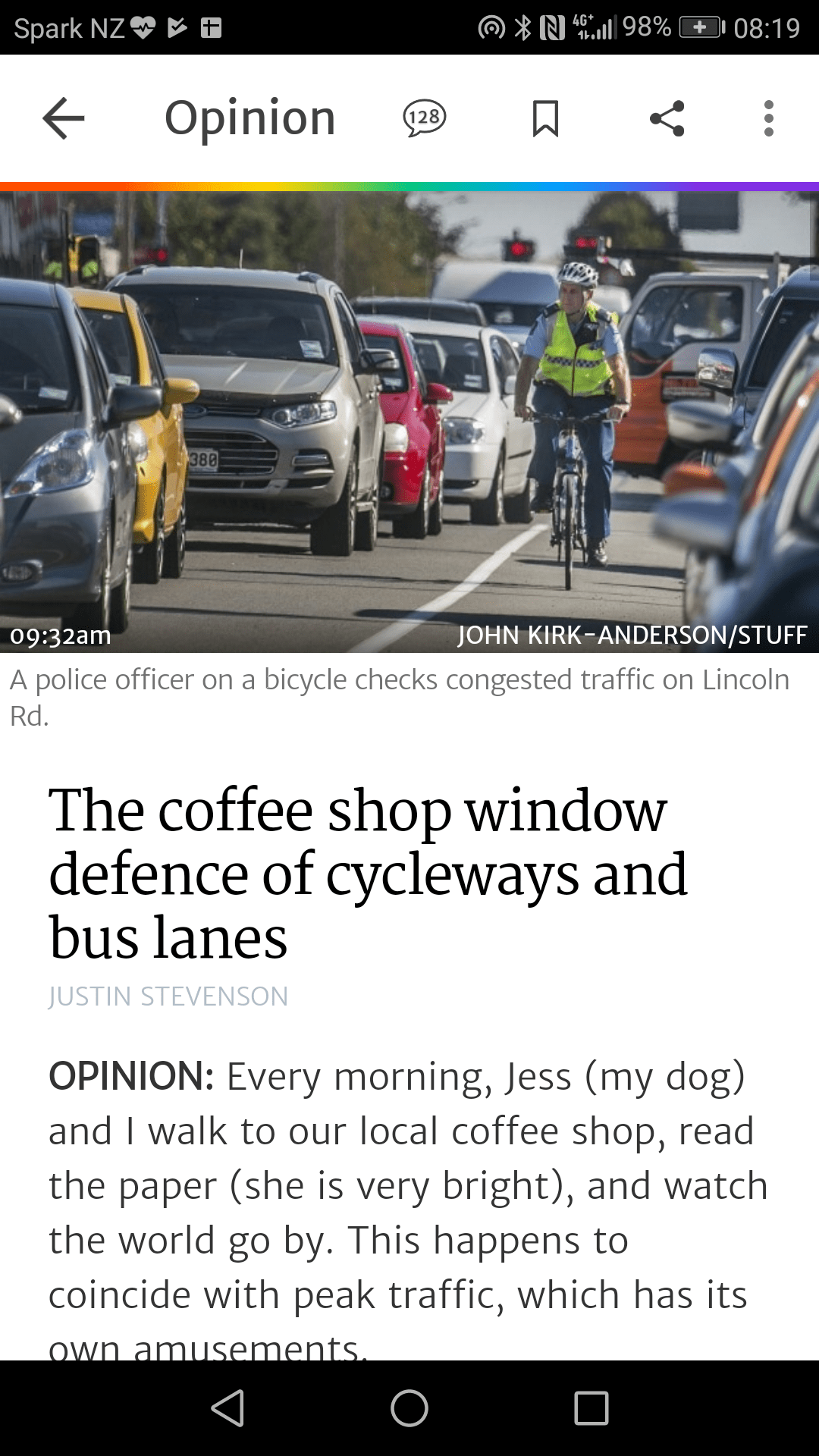
For the record, this piece is looking at a specific “edge” case where cycleways and public transport MIGHT be a good solution and be of benefit those who drive, i.e. when, and only when, traffic is already heavy. When traffic is flowing well then other arguments come into play. In particular, within reason, people should be able to travel around in whatever way they prefer. Admittedly this is a harder argument as the costs and benefits between users are not as clear and harder to quantify.