More controversial and interesting, but not noticed – How to sell an asset without selling an asset

This piece was picked up by The Press and STUFF last week, which was nice.

Regular readers might recognise it as a rework of a previous post where I was making a case that arguments over public asset sales distracted from an easier debate over asset allocation. Since I didn’t get any bites about this orginal piece I was in the process of reworking it, pointing out that asset sales were happening under a different guise, when the whole topic hit the papers again. So in it went. 

I think the big lesson here is that if I want to get published in the paper regularly I will probably need 3-5 topics on the slow burn so I can take advantage of what is topical. I am not sure if I have that many topics! 🙂

The other interesting thing is that although it was in the paper (great!) to get rapid feedback you need to be on the front section of STUFF. In all there were only 12 comments, which was a bit of a fail really.

_____________________________

How to sell a public asset without selling an asset

After a brief hiatus asset sales have once again been mooted as an option for the Christchurch City Council to address its financial situation. This will no doubt disappoint those who believe the council should maintain its ownership stakes.

Those same people may be discouraged to learn that their opposition has not prevented a sell down on the sly. However, this is what appears to have happened with council owned Red Bus.

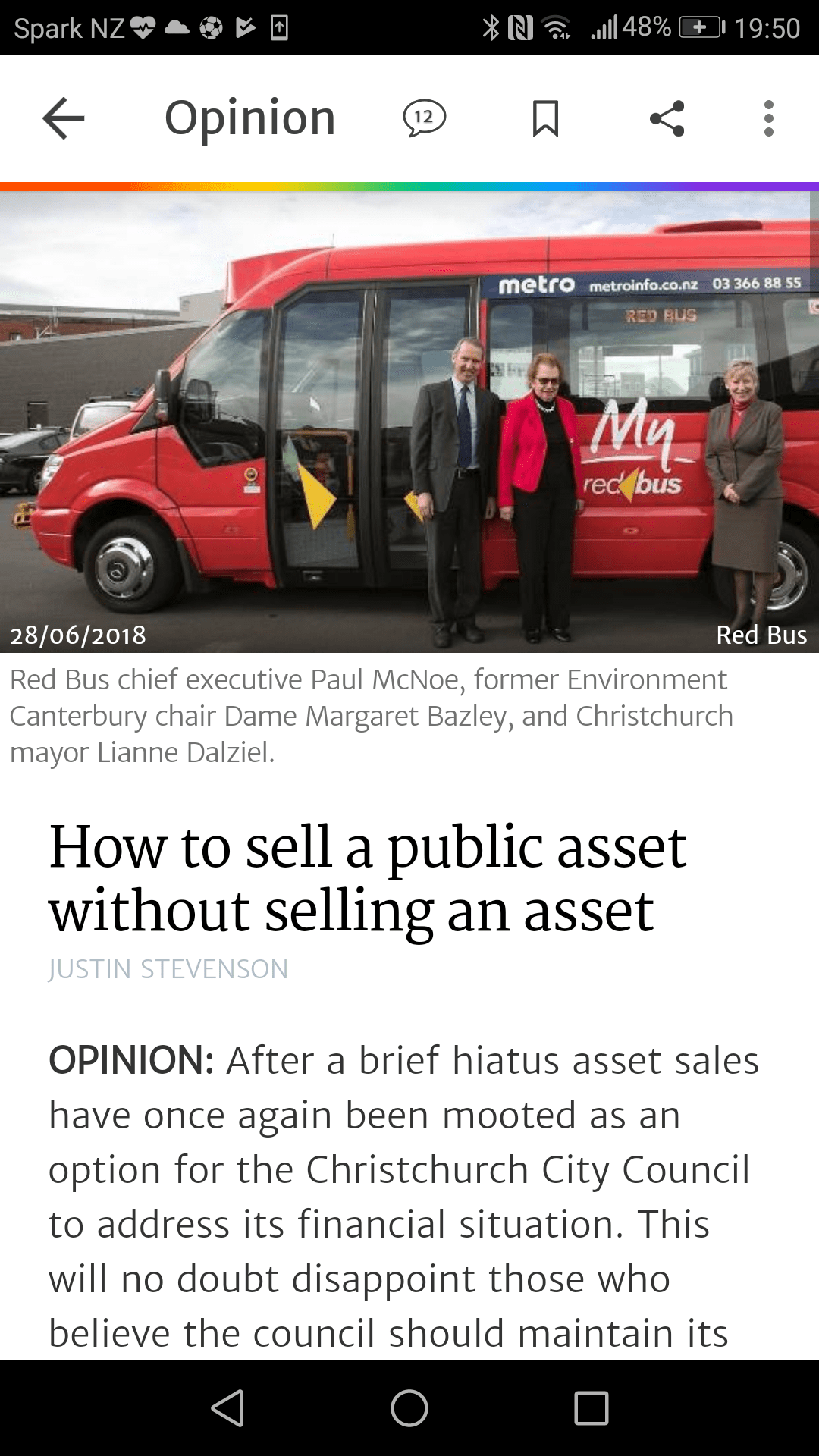
Red Bus is a bit of a problem child for the council and has been for many years. Not only does it struggle to retain bus routes in the face of private companies like Go Bus (an indicator of operational inefficiency for a public owned company), it barely makes a profit while sitting on a large amount of assets.

These assets could easily redeployed into better things (think “asset allocation” instead of asset sales), significantly benefiting the community.

While a good case could be made for selling Red Bus outright, it seems the risk of a PR backlash has meant that other avenues have been explored.

For example, the 2017 accounts indicated some odd behaviour. Despite make an operating profit of only $132,000 Red Bus was able to pay out a relatively hefty dividend of $1.35 million.

This is a good trick, but how was it achieved?

Despite a relatively small operating profit, a “consolidated profit” of $2.37 million was declared. For those wondering about the difference, the latter was largely the result of having extensive property assets revalued upwards by $2.38 million (+16%). A nice lift, but sitting on land and waiting for an increase in value is hardly a sign of managerial brilliance for a bus company. Pretty much all long term homeowners in New Zealand achieved this!

Red Bus then went to the bank, used the higher valuation to obtain a loan, and paid this money as a dividend to the CCC.

An equivalent situation would be using the increased value of your house to obtain a loan to pay for food. While it may be necessary at times, no one would suggest it makes you wealthier. You certainly cannot do it forever as eventually your equity runs out.

This is essentially what happened at Red Bus. The increase in value was sold to the bank for cash which was then passed onto the council.

This is called “releasing capital” which sounds better than “asset sales”, but both have the same effect of reducing the equity owned by the council.

Since paying a dividend of this size puts even more strain on a poorly performing company, significant pressure must have been applied. The substance of such actions are at odds to Mayor Lianne Dalziel’s statement that the council is “not considering asset sales”.

As it happens, selling down Red Bus is probably not a bad idea. Even in the latest financial year its return on assets was a miserable 0.8%. You could instead sell all the fixed assets in Red Bus, invest in a commercial property and receive 8 times as much for far less effort. Not doing so effectively costs rate payers around $2.3 million a year in lost income for no discernable benefit.

Although small compared to the overall council budget, $2.3 million a year is not chump change. There are clearly many good uses for this in Christchurch (I can certainly think of a few, can you?) and it is odd that the council has not taken advantage of this easy income stream.

The good news is that Red Bus is a small component of the council’s asset portfolio. With a bit more digging and some sensible asset allocation decisions the council’s financial position could be better than it appears.

_________________

Justin Stevenson has a Ph.D. in Engineering and a post-grad diploma in Economics. He really wants to see the city using its resources in a way that benefits the community the most.

If asset sales are no longer an option, how about asset allocation? (2018 update)

This is an updated version of the previous post “If asset sales are no longer an option, how about asset allocation?”   . Frankly, it didn’t take much work as not a heap as changed with the state of Red Bus

_____________________

All appearances suggest that asset sales are not being considered by the Christchurch City Council (CCC). This will please many as there are good reasons for keeping publicly owned assets. However, advocating for council ownership should not prevent sensible discussions about asset allocation.

Simply put, are CCC assets performing well, or should they swap them for something else? If we are going to keep the family silver, shouldn’t we make sure what we have is in fact silver!

For example, consider Red Bus. Is it worth the CCC owning this asset, or could it do better?

The annual report for Red Bus is freely available so we can get significant insight into this company’s performance. So what does this reveal?

With publicly owned companies it is inadequate to focus only on financial performance as there are often important, but more intangible, valuation considerations. They may be a monopoly provider, or they may provide some form of public good that the private sector would not deliver.

A useful thought experiment is to ask, “what would happen if this company ceased to exist?” What would be lost that the numbers do not show?

With Red Bus the answer is pretty clear, not much!

Despite appearances, Red Bus is not responsible for providing public transport in Christchurch. ECAN is. Red Bus simply tenders to provide bus routes along with other companies.

And they often lose. Currently only 30% of routes are performed by Red Bus with private firms like Go Bus delivering the rest.

If Red Bus stopped providing bus services your average bus user wouldn’t notice the slightest difference.

So why does Red Bus exist? It exists because the CCC believes it can operate a bus company profitably and receive a healthy dividend. Therefore, we can largely ignore any intangible benefits and focus primarily on its financial performance.

So how did they do?

Last year Red Bus declared a pre tax operating profit of $303,000 on turnover of just over $20.5 million. Better than last year but still a very skinny margin around 1.5%.

“running to stand still” is the phrase that comes to mind.

Of more concern is the amount of resources used to get this small profit. The accounts list net assets at a shade under $38 million, implying a return on assets of 0.8%.

If Red Bus was sold, and different assets purchased, what return could we expect from $38 million? As a comparison we could:

  1. Put the money into a bank deposit. With interest rates currently around 3.5% this is worth $1.35 million per year.
  2. Buy some industrial property. A 7% return should be possible so this is worth $2.6 million per year.
  3. Attempt to mimic the performance of Ngai Tahu’s commercial arm which made around 15% a year since settlement. This is around $5.5 million a year.

None of these options would compromise the provision of a public bus service. ECAN would simply contract to another company. In each case we would get the bus service PLUS the extra money.

A 7% return via option 2 is not an unreasonable expectation. What does Red Bus aim for? Apparently it has a target of $300k. Although they have achieved this “heroic” goal, 8 times this could have been achieved with far less effort!

Some conclusions can be drawn:

  • Red Bus is inefficient as even with its thin margin it can’t keep private providers (who tend to be very rational about profit) at bay.
  • Red Bus is very asset rich but makes virtually no return on those assets.
  • If the council wants a dividend from assets there are far easier options than owning this bus service.
  • Owning this company effectively wastes around $10 per ratepayer annually.

It would seem that selling up, letting others provide the bus service, and buying better assets is a reasonable alternative.

Red Bus is a tiny component of the CCC asset portfolio. However, even reallocating these resources could significantly improve the life of ratepayers. Even if only used for transport in the city an extra $2.6 million per year could be used to:

  • Give away 1 million free bus tickets to encourage more users.
  • Give 7000 bikes away.
  • Give 1500 E-bikes away.
  • Provide 86,000, $30 taxi trips.
  • An additional 3% more bus routes could be provided

These are just some options available, and they would be additional to the existing bus system.

Get creative. What would you do?

It is not unreasonably that all CCC owned companies should receive the same attention (hint, City Care deserves a look for starters). As ratepayers we should ensure that they are achieving even a basic level of performance so we are able to enjoy the benefits. As demonstrated with Red Bus, not doing so could be leaving our community significantly worse off than it could be.

If asset sales are no longer an option, how about asset allocation?

A different perspective on how to use public assets

For those used to a diet of Camino related blogs this one might come as a bit of a shock. For those that know me and my interest in governance, economics, and business – not so much. 

This was intended as an opinion piece for the the local paper in Christchurch, The Press. Alas, no word was heard :-). 

I am very interested in responses to this piece as the line of reasoning has far wider application than the example it has been applied to. I for one think that the way society wastes its resources is a scandal, particularly when done in the name of good intentions. So many people are missing out on help that we could be delivering if we were a little more sensible.  

Initially written: 13/2/2017

All appearances suggest that asset sales are no longer being considered by the Christchurch City Council (CCC). This will please many people as there are good reasons for keeping publicly owned assets.  However, supporting this should not prevent sensible discussions about asset allocation.

Simply put, are the assets the CCC has performing well, or should they swap them for something else? If we are going to keep the family silver, shouldn’t we make sure what we have is in fact silver!

For example, consider Red Bus. Is it worth the CCC owning this asset, or could it do better?

The annual report for Red Bus is freely available so we can get significant insight into this company’s performance. So what does this reveal?

First, with publicly owned companies it is inadequate to just focus on financial performance. Care needs to be taken to consider important, but more intangible, reasons for public ownership. They may be a monopoly provider, or they may provide some form of public good that the private sector would not deliver.

When considering businesses like this it is worth performing a thought experiment and ask, “what would happen if this company ceased to exist?” What would be lost that the numbers do not show?

With Red Bus the answer is pretty clear, not much! Despite appearances, Red Bus is not responsible for providing public transport in Christchurch. ECAN is. Red Bus simply tenders to provide bus routes along with other companies.  And they often lose. Currently only 30% of routes are performed by Red Bus with private firms like Go Bus delivering the rest.

If Red Bus stopped providing bus services your average bus user wouldn’t notice the slightest difference.

So why does Red Bus exist? It exists because the CCC believes it can operate a bus company profitably and receive a healthy dividend. Therefore, we can largely ignore any intangible benefits and focus primarily on its financial performance.

So how did they do?

Last year Red Bus declared an operational profit of $132,000 on turnover of just over $19 million. Better than last year but still a very skinny margin of 0.7%. Probably the simplest way to describe this is “running to stand still”.

Of more concern is that a lot of resources were used to get this small profit. The accounts list net assets at a shade under $38 million, implying a return on assets of 0.3%.

If Red Bus was sold, and different assets purchased, what return could we expect from $38 million? As a comparison we could:

  1. Put the money into a bank deposit. With interest rates currently around 3.6% this is worth $1.4 million per year.
  2. Buy some industrial property. A 7% return should be possible so this is worth $2.6 million per year.
  3. Attempt to mimic the performance of Ngai Tahu’s commercial arm which made around 15% a year since settlement. This is around $5.5 million a year.

None of these options would compromise the provision of a public bus service. ECAN would simply contract to another company. In each case we would get the bus service PLUS the extra money.

A 7% return via option 2 is not an unreasonable expectation. What does Red Bus aim for? According to its report it has a profit target of $400k, or a 1% return on assets. This is hardly a heroic goal and they have failed to achieve even that. With far less effort they should be able to achieve 7 times this!

So what do I conclude?

  • Red Bus is operationally inefficient as even with its thin margin it can’t keep other private providers (who tend to be very rational about profit) at bay.
  • Red Bus is very asset rich but makes virtually no return on those assets.
  • If the council wishes to receive a dividend from its assets there are far easier options than owning this bus service.
  • By owning this company the council is effectively wasting around $10 per ratepayer annually.

My response? Sell the assets in this company, let others provide the bus service, and buy other assets which will deliver a decent return.    

Red Bus is a tiny component of the CCC asset portfolio. However, even reallocating these resources could significantly improve the life of ratepayers. Even if only used for transport in the city an extra $2.6 million per year could be used to:

  • Give away 1 million free bus tickets to encourage more users.
  • Give 7000 bikes away.
  • Give 1500 E-bikes away.
  • Provide 86,000, $30 taxi trips.
  • An additional 3% more bus routes could be provided

These are just some options available, and they would be additional to the existing bus system.

Get creative. What would you do?

It is not unreasonably that all the companies owned by the CCC should receive the same attention. As ratepayers we should ensure that they are achieving even a basic level of performance so we are able to enjoy the benefits. As demonstrated with Red Bus, not doing so could be leaving our community significantly worse off than it could be.