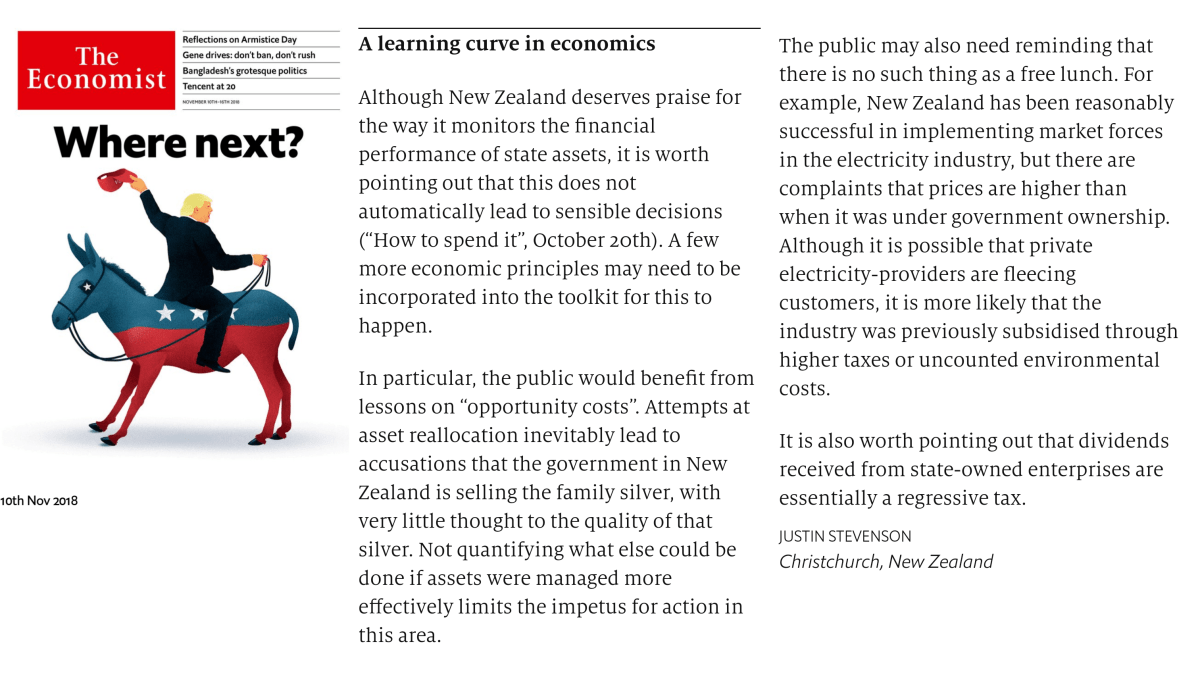
I have reached the summit! The Economist has published a letter by me! Little old me! Admittedly, this means that I share the same page as ambassadors for despot countries, desperate to defend their nation’s record against the latest Economist feature, but who cares!
For those interested in the topic, whenever NZ is featured in an article it is either rare, brief, and usually, favorable. In this case, it was all three as NZ received top billing as a country where government-owned assets were accounted for. High praise indeed.
While I think this is probably true, I felt that is was necessary to point out that knowing stuff does not lead to great decisions. The ongoing battles about this in NZ are a testament to this.
As it was The Economist did truncate the letter a bit, even dropping the Dr from my name. Here is the full text
_________________________________
Dear Sir
Although New Zealand deserves praise for the way it monitors state assets and their financial performance (“How to plug budget holes by managing public wealth better”, Oct 20th, 2018), it is worth pointing out that knowing what is going on does not automatically lead to sensible decisions. A few more economic principles may need to be incorporated into the toolkit for this to happen.
In particular, the public would benefit from lessons on “opportunity costs”. Attempts at asset reallocation inevitably lead to accusations that the NZ government is “selling the family silver” with very little thought to the quality of that silver. Not quantifying what else could be done if assets were managed more effectively limits the impetus for action in this area.
They also need reminding there is “no such thing as a free lunch”. As an example, while NZ has been reasonably successful in implementing market forces into its electricity generation, there are complaints of higher prices than under government ownership. While it is possible that private electricity providers are “fleecing” customers, it is more likely that the industry was previously subsidised via higher taxes or uncounted environmental costs.
It is also worth pointing out that dividends received from state-owned enterprises (SOEs) are essentially a regressive tax. For context, dividends from SOE’s in NZ are equivalent to about US$700 per person, effectively a flat tax paid equally irrespective of income.
A potential improvement would be for SOE dividends to be paid directly to citizens rather than into the government coffers. This income would then be taxed at respective marginal tax rates, addressing the equity issue. It would also go some way to making the opportunity cost of poorly performing assets more real as it would affect everyone’s back pocket.
Dr. Justin Stevenson
Christchurch
New Zealand
 Rough against rough